

Mapping Memory: UT Researchers Reclaim Bastrop’s Past
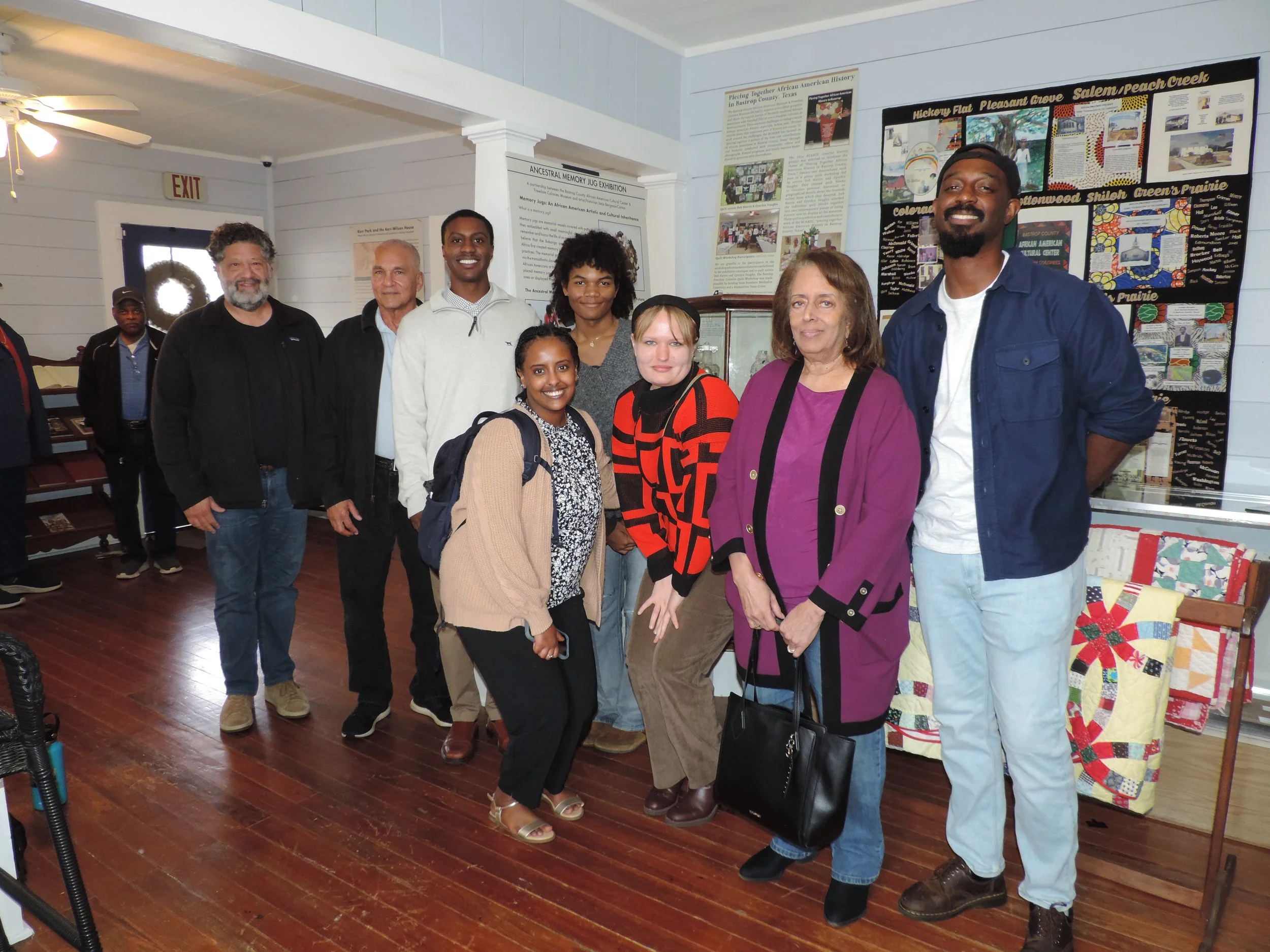
UT Research Team at the Bastrop County African American Cultural Center & Freedom Colonies Museum
From right to left: Dr. Rich Aman, Dr. Ted Gordon, Aaron, Jaden, Hannah, Mia, Roxanne Evans, Ricardo, gathered with Members of the Museum to share ongoing Bastrop Township and County census mapping research.
On a recent afternoon inside the Bastrop County African American Cultural Center & Freedom Colonies Museum, history was not simply discussed—it was mapped, questioned, affirmed, and reclaimed. Community members, historians, and University of Texas researchers gathered for a powerful exchange centered on Bastrop Township and Bastrop County census mapping, a project that brings visibility to life, land, and legacy from the mid-19th century through the mid-20th century.
The gathering opened with a warm welcome from Belinda Davis, board member of the Bastrop County African American Cultural Center, who thanked attendees for coming and acknowledged the significance of the work being shared. Speaking from within the Museum itself, Davis reminded the room that this research represents a blessing to the African American community of Bastrop—one rooted in truth, preservation, and reciprocity. She emphasized that the community stands ready not only to receive the findings, but to support the researchers in return.
Longtime community advocate David Collins echoed the sentiment, reflecting on how much of Bastrop’s history remained unknown even to those who grew up here. Belinda Davis captured the spirit of the room just as plainly: “We love history, y’all.” In that moment, the space felt exactly as it was intended to be—where lived memory and academic research met as equals.
A Collaborative Approach to Historical Truth
Leading the presentation was Dr. Ted Gordon of the University of Texas, joined by a research team that included postdoctoral scholars, graduate students, undergraduate researchers, and research administrators. Rather than positioning the university as the sole authority, Dr. Gordon emphasized collaboration, naming Bastrop’s community as essential partners in the work.
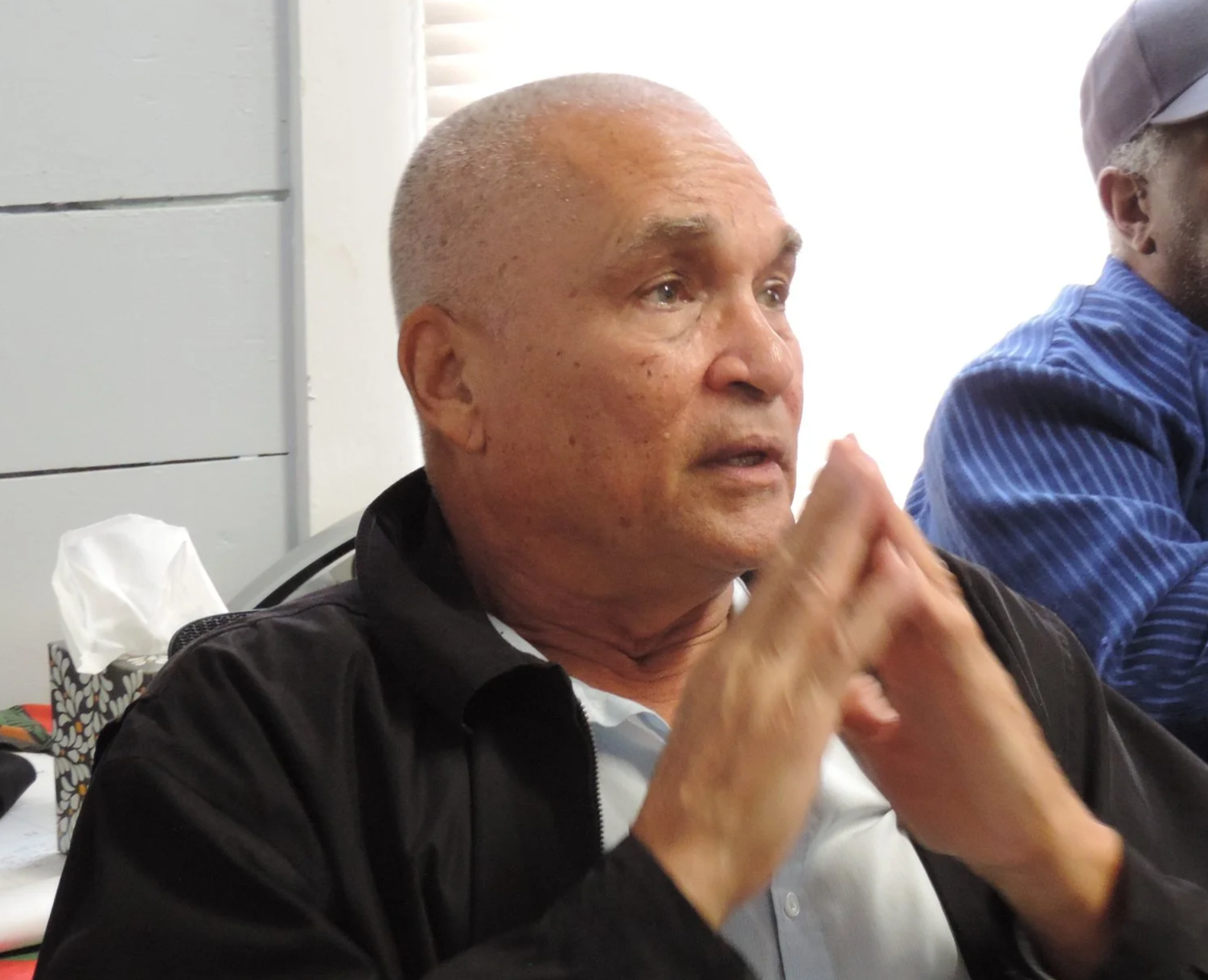
“This kind of research cannot be done without community,” Gordon explained. “Otherwise, it becomes disconnected.” He noted that Bastrop stands out in Central Texas as a place where African American residents have not only preserved history, but built infrastructure around it—through museums, books, oral histories, and active stewardship of place.
The Bastrop project builds on more than five years of prior work mapping Black communities in Austin, a massive effort that produced a database of over 100,000 individuals. That work digitally reconstructed every dwelling in Austin city limits from 1880 to 1950, identifying racial identity, family structure, occupation, and household composition. Using interactive maps, users can click on a single dot—representing a household—and view detailed census profiles of the families who lived there.
Now, that same methodology is being applied to Bastrop Township, with plans to expand to Smithville and the full county.
Seeing the Past on the Map
Undergraduate researcher Jaden guided attendees through the technical heart of the project: georeferenced historical maps layered over present-day geography. Using 1944 Sanborn Fire Insurance Maps, the team aligned historic landmarks—railroads, streets, creeks, and public buildings—with modern maps to accurately locate past residences.
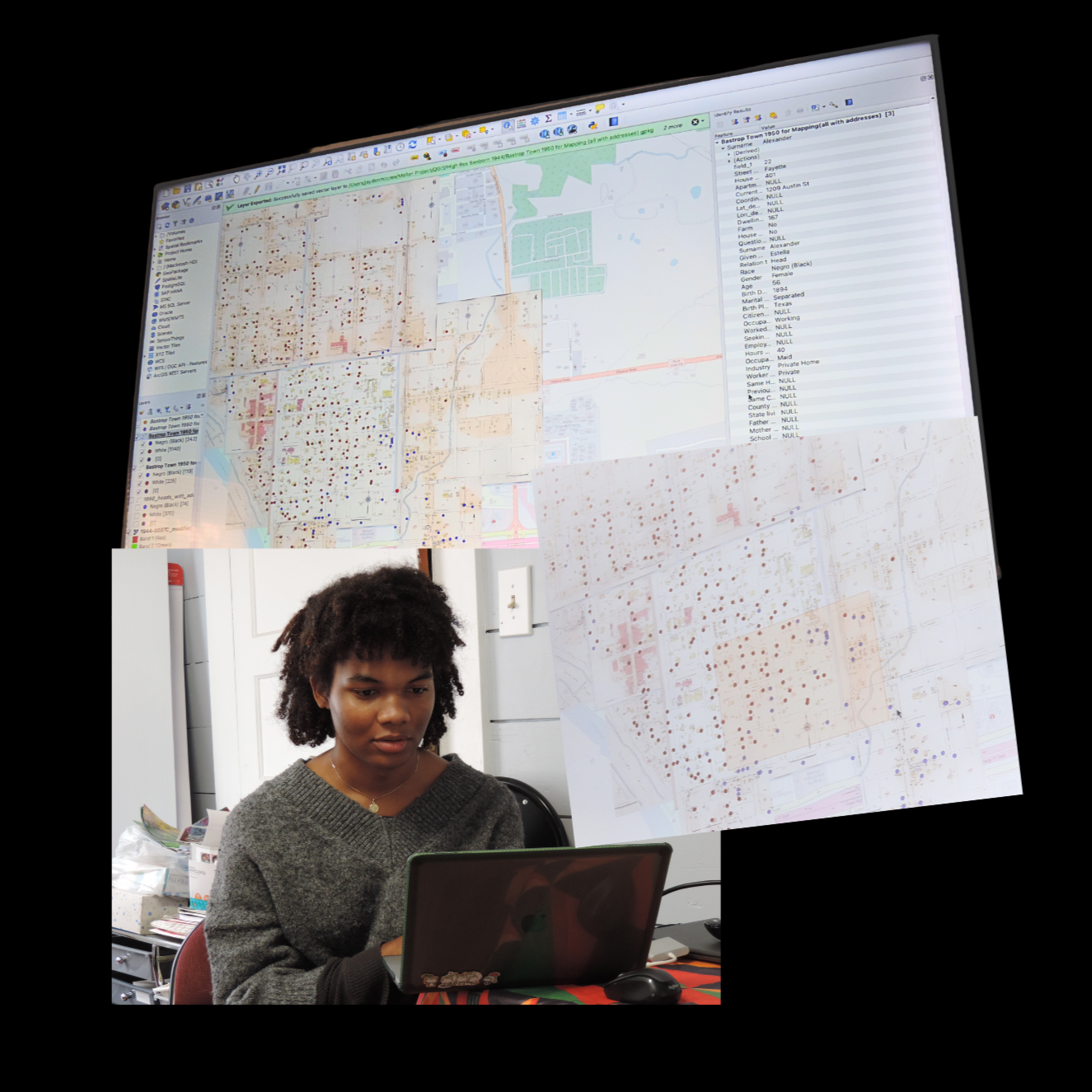
Each census household is represented by a dot:
Blue dots for Black families
Red dots for white families
Clicking on a dot reveals census records transcribed line-by-line from original enumerator sheets and carefully cleaned for accuracy. Names, ages, marital status, occupation, birthplace, and household relationships emerge—transforming abstract data into human stories.
For many in the room, this was not theoretical history. Community members recognized surnames, addresses, and neighborhoods. Questions arose about specific families—Franklin, Kerr, Weeks—prompting thoughtful discussion about census limitations, township boundaries, farm residences outside town limits, and the reality that some families were missed or recorded under different heads of household.
Rather than diminishing the work, these conversations strengthened it.
“This is a work in progress,” the researchers emphasized. “And community knowledge is critical to getting it right.”
Patterns of Land, Race, and Resilience
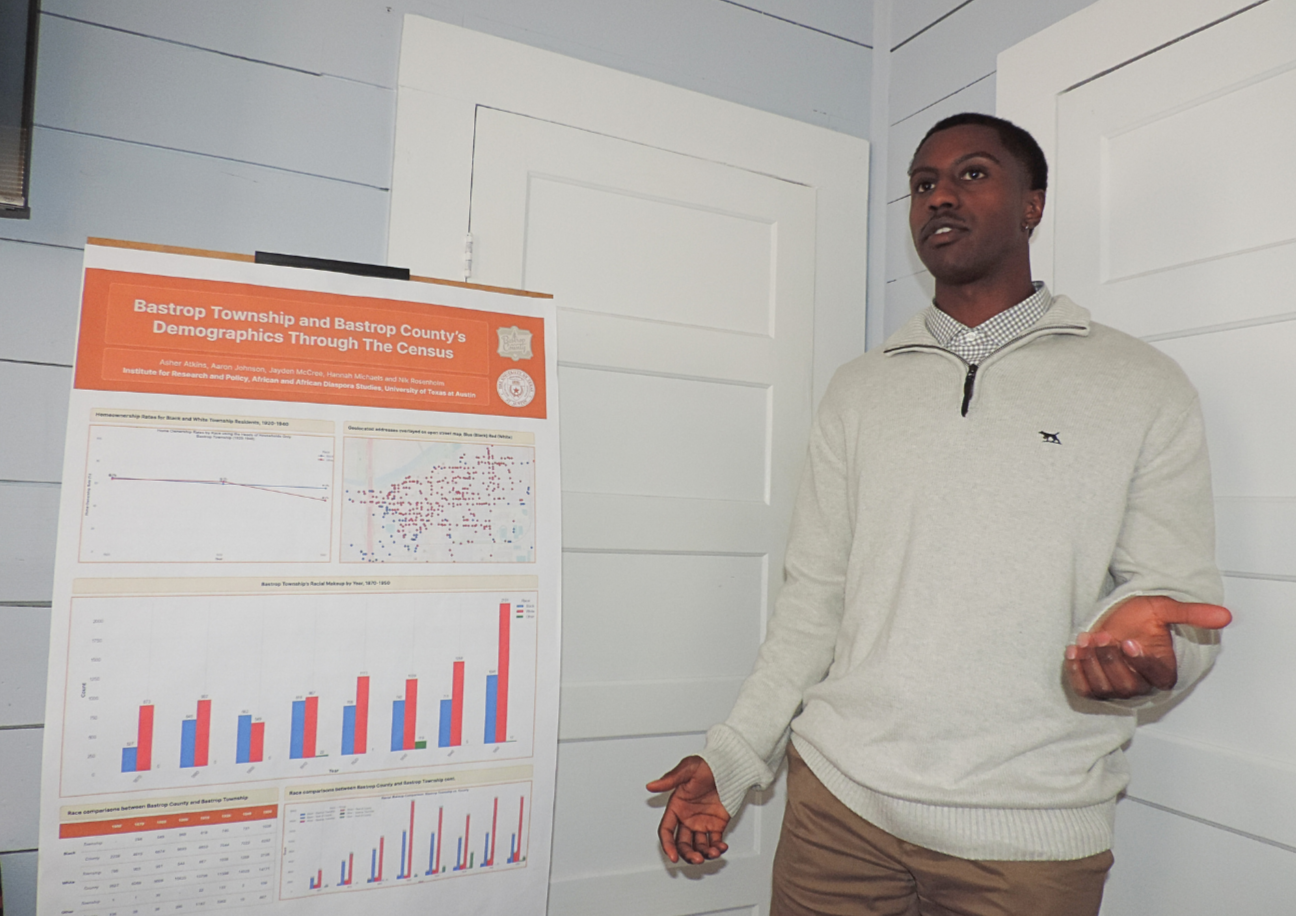
Beyond mapping individual households, the team presented data analysis examining racial demographics and homeownership patterns from 1870 to 1950. Contrary to common assumptions, Black homeownership rates in Bastrop Township during the early 20th century were often comparable to—and at times higher than—white ownership rates, a finding consistent with earlier research in Austin.
The data also revealed striking population shifts. In at least one census year, Black residents outnumbered white residents in the township—raising questions about migration, labor, segregation, and economic change. Researchers acknowledged that racial categories themselves shifted over time, reflecting evolving—systems of classification.
These findings sparked curiosity rather than closure.
“What was happening here before 1900?” one attendee asked.
“That’s where the story begins,” another responded.
Where Data Meets Story
Throughout the event, a central theme emerged: data alone is not enough.
Researchers spoke openly about the need to integrate census mapping with oral histories, church records, cemetery data, land deeds, family books, and community memory. Several attendees offered resources, including locally published histories and personal knowledge of land transactions, church involvement, and generational migration.
The conversation expanded into the future—toward visual storytelling, artistic interpretation, and three-dimensional historical reconstructions. Examples were shared of bird’s-eye maps, 3D renderings, and creative collaborations already underway in Austin, prompting excitement about what might be possible for Bastrop’s Freedom Colonies and South End District.
A Shared Commitment Going Forward
As the afternoon closed, the tone was unmistakably hopeful. The UT team expressed a strong desire to return, present to larger community groups, and tailor future work to support ongoing South End District initiatives. Community leaders affirmed their openness to continued partnership, shared stewardship, and mutual accountability.
This gathering was not merely a presentation—it was a reunion of disciplines, generations, and intentions.
In Bastrop, history is not being uncovered by outsiders and archived in silence. It is being mapped with the community, questioned by descendants, and preserved with purpose.
And in Bastrop’s communities, the dots on the map are no longer anonymous—they carry names, stories, and living witnesses committed to ensuring they are remembered.
